Hey everyone, Sam here from your go-to trailer brake supplier, and today we’re diving into a question I get at least three times a week from folks hauling everything from a tiny pop-up camper to a full-on work trailer loaded with construction gear: How much weight can electric trailer brakes actually hold? Trailer Brake

Look, I get it. When you’re outfitting your rig, you don’t just want a random number off a spec sheet—you want something that makes sense, something that matches what you’re towing, and something that won’t leave you stuck on a steep hill at 2 a.m. Because let’s be real, trailer brakes aren’t just a “nice to have” when you’re hauling heavy stuff—they’re the only thing stopping you, your trailer, and everything inside from becoming a highway obstacle.
First off, let’s break down what electric trailer brakes even are, for anyone who’s new to the game. Unlike hydraulic brakes (the ones in your tow vehicle), electric trailer brakes work on a simple principle: when you hit your tow vehicle’s brake pedal, a signal gets sent to the brake controller, which sends a small electric current (usually between 12 and 14 volts) to the magnets inside each brake assembly. Those magnets engage, pushing the brake shoes out against the trailer’s brake drum, creating friction to slow or stop the trailer. No extra hydraulic lines to mess with, which is why they’re the most common for trailers under, well… most weights we’re talking about here.
Now, the big question: weight capacity. Let’s cut through the confusion—there’s no one-size-fits-all number, and that’s a good thing because different brake parts are built for different jobs. The main thing that determines how much weight an electric trailer brake can hold is the size of the brake drum and the brake shoes, right? The two most common sizes you’ll see are 10-inch and 12-inch brakes. Let’s talk numbers here, because this is where the rubber meets the road (pun intended, sorry—I can’t help myself).
10-inch electric trailer brakes: These are the workhorses for smaller to mid-sized trailers, like boat trailers, utility trailers, or small car haulers. Most 10-inch brake assemblies are rated for axle loads up to 3,500 pounds per axle. Wait, axle load—important to note that, not total trailer weight. If you have a single-axle trailer with two 10-inch brakes, that means your axle max is 3,500 lbs, so total trailer weight (fully loaded) should be around that 3,500 lb mark, right? Wait, no—actually, I always tell folks to leave a little cushion. You don’t want to run at 100% capacity, because that wears out the brakes faster. Most 10-inch brakes handle up to 3,500 lbs per axle, but I’d say sweet spot is 2,000 to 3,000 lbs per axle for regular use, with a maximum occasional load of 3,500 if you really need it. I’ve seen guys load a 10-inch brake axle to 3,600 lbs once, but that’s pushing it—those brakes will get hot fast, and overheat if you’re going down a long grade, which kills stopping power and can even damage the magnets.
Then there are the 12-inch electric trailer brakes. These are the heavy hitters. If you’re hauling a big fifth wheel, a horse trailer, a construction trailer loaded with pallets of bricks, or a large travel trailer, you’re on 12-inch brakes. Most 12-inch assemblies are rated for axle loads from 6,000 lbs all the way up to 10,000 lbs per axle. That’s a huge jump, right? The larger drum and bigger brake shoes mean more surface area for friction, so they can handle way more weight without overheating. I’ve supplied 12-inch brakes for single-axle trailer hauling small excavators (those things are like 8,000 lbs alone) and they hold up fine, as long as you’re within the axle rating. Again, though—don’t max them out all the time. The sweet spot for 12-inch brakes is 5,000 to 9,000 lbs per axle, depending on the exact model. Some of the heavy-duty 12-inch ones we carry are rated for 10,000 lbs, but you better have a tow vehicle that can actually pull that weight too—brakes are only half the equation.
Wait, hold up—there’s a common myth I need to bust right now. A lot of people think that more brakes equal more weight capacity. Like, if you have a tandem axle trailer, adding more brakes will let you haul more. Not exactly. Each individual brake assembly is rated for that axle load, so if you have two axles, each rated for 3,500 lbs, your total trailer max is 7,000 lbs, regardless of how many brakes you have. Tandem axles usually have two brakes (one per axle) or four brakes (two per axle)—but the capacity is still per axle. So don’t fall for that “upgrade to four brakes to haul 10k” line if your axles are only rated for 3.5k each. That’s a quick way to burn out brakes and get in trouble.
Another big factor that people sleep on: brake controller settings. I’ve seen trailer brakes with a 3,500 lb axle stop a 3,500 lb trailer fine, but when the controller is cranked all the way up to “max” every time, the brakes wear out in half the time and can overheat. The controller sends the signal proportional to how hard you hit the tow vehicle brakes, right? Most good controllers let you adjust the gain—so you can set how much power is sent to the brakes based on your trailer’s weight. If you set the gain too high, the brakes will lock up, which is bad for stopping and bad for the brakes themselves. Set it too low, and the tow vehicle’s brakes have to do all the work, which is also bad. Getting that setting right makes a huge difference in how much weight the brakes can handle, and how long they last.
Also, brake maintenance. Duh, right? If you never change your brake shoes, or let the drums get all rusty or warped, even a 12-inch brake won’t hold 5,000 lbs. I see this all the time—folks buy a new trailer, never touch the brakes, and then wonder why the stopping distance is double what it should be. Electric trailer brakes need to be inspected every year, or every 10,000 miles, whichever comes first. Clean the drums, check the magnets, adjust the brake shoes so they’re not too loose or too tight, lubricate the moving parts (but not the shoes or drums—oil on the brakes is the worst). I had a customer last month who bought a used 10k lb trailer, and the previous owner never lubricated the brake cams. The brakes were dragging so bad that the drums were glowing red, and the magnets were fried. That trailer’s brakes could have handled 10k lbs if they’d been maintained—instead, they were basically useless.
Wait, what about surge brakes? No, today we’re talking electric, but I should mention that electric is different from hydraulic surge, but the weight capacity rules still apply. Surge brakes are activated by the trailer’s momentum, but electric is easier to integrate with most modern tow vehicles, which is why they’re more popular for a lot of people.
Let’s also talk about real-world examples, because numbers are great, but actual use cases help. I have a buddy who runs a landscape business—he has a tandem axle utility trailer, each axle rated for 3,500 lbs, with 10-inch electric brakes. He hauls lawn mowers, pallets of mulch, and topsoil. Fully loaded, that trailer is usually around 6,000 to 6,500 lbs total. That works out to 3,000 to 3,250 lbs per axle, which is well within the 10-inch brake sweet spot. He’s been using the same set of brakes for four years now, no issues. Another customer of mine is a camper owner—he has a 28-foot travel trailer, tandem axle, each axle with 12-inch brakes, rated for 6,000 lbs per axle. Fully loaded, his trailer is around 11,500 lbs, so just under 6k per axle, perfect. He once had to stop abruptly on a wet highway, and those brakes stopped his trailer in half the distance his friend’s 10-inch brake trailer did.
Now, the fine print: not all electric trailer brakes are created equal. That’s why I’m not just giving you generic numbers here. The brakes we supply are built with high-grade magnets and steel drums, so their rated capacities are actual usable numbers, not just marketing fluff. Some cheap off-brand brakes you find at the big box store might be rated for 3,500 lbs, but in reality, they can only handle 2,500 lbs before overheating. We test every brake assembly we sell, so you can trust the spec.
Another thing to consider: terrain and how you drive. If you’re hauling heavy stuff around flat terrain, brakes can handle more. But if you’re going up and down steep hills, like in the mountains, you need extra brake capacity, and you need to use your trailer brakes more, not just your tow vehicle brakes. That extra heat from repeated stops on a grade is the biggest enemy of electric brakes. Even a 12-inch brake rated for 10k lbs will start to fade if you’re going down a 6% grade for 10 miles straight with a fully loaded trailer. So in those cases, you might want to go up a size, or make sure your controller is set correctly so you’re not riding the brakes the whole time.
Wait, what about brake capacity vs. towing capacity? A lot of new tow vehicle owners mix these up. Towing capacity is how much your tow vehicle can pull total. Brake capacity is how much the trailer’s brakes can stop. They have to match, right? If your tow vehicle is rated to pull 10,000 lbs, but your trailer’s brakes are only rated for 6,000 lbs, that’s a problem. You can’t stop 10k lbs with 6k lb rated brakes. So always make sure the trailer brake capacity is at least equal to your trailer’s fully loaded weight, and your tow vehicle’s towing capacity.
Let me wrap this up with a quick cheat sheet, because I know you’re already scanning for the numbers:
- 10-inch electric trailer brakes: Best for single-axle trailers up to 3,500 lbs per axle, sweet spot 2,000-3,000 lbs per axle.
- 12-inch electric trailer brakes: Best for tandem or heavy single axles, rated 6,000-10,000 lbs per axle, sweet spot 5,000-9,000 lbs per axle.
- Always add a 10-15% weight cushion for safety, maintain your brakes, set your controller gain, and match brake capacity to your total trailer weight.
At the end of the day, electric trailer brake weight capacity isn’t a random number—it’s based on parts, maintenance, how you drive, and how you set up your rig. Too many people underestimate how important good brakes are, and how much they can handle when set up right.
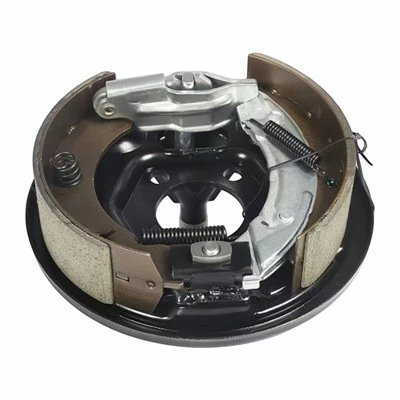
If you’re still not sure what size brakes you need for your trailer, or you want to upgrade your old worn-out brakes, hit us up. We don’t do pushy sales stuff—we just tell you what works for your specific load and trailer. We can walk you through checking your axle rating, measuring your current drums, and picking the right brakes that’ll keep you safe on every trip, no matter how heavy your haul. No weird fine print, no overpriced junk—just solid brakes that do the job.
Brake Drum References:
Trailer Brake Association Technical Manual. National Association of Trailer Manufacturers. 2022.
SAE International Standard J2807: Performance Requirements for Trailer Brake Systems. Society of Automotive Engineers. 2021.
Electric Trailer Brake Efficiency Testing Report. Department of Transportation, National Highway Traffic Safety Administration. 2020.
Dongying Hongta Automobile Fitting Co., Ltd.
We’re known as one of the most professional trailer brake manufacturers and suppliers in China, also support customized service. Please feel free to wholesale durable trailer brake for sale here from our factory. For price consultation, contact us.
Address: No. 817 Bingsheng Road, Guangrao Economic Development Zone, Guangrao County, Dongying City, Shandong Province
E-mail: Amanda_song@hongtabrakes.com
WebSite: https://www.hongta-brake.com/
