If you’re a parent shopping for your kid’s first trampoline, you’ve likely stared at two dominant shapes and wondered which makes sense: round or square. As a children’s trampoline supplier who’s been testing, sourcing, and helping families pick these products for over a decade, I’ve seen firsthand how shape isn’t just a cosmetic choice—it’s tied to safety, play style, and even how your kid develops motor skills while jumping. Too many parents default to “round is the classic” without digging into why, or assume square is just a trendy alternative, and that’s where missteps happen. Let’s break down the differences so you can pick something that fits your kid, your yard, and their play habits. Children’s Trampolines
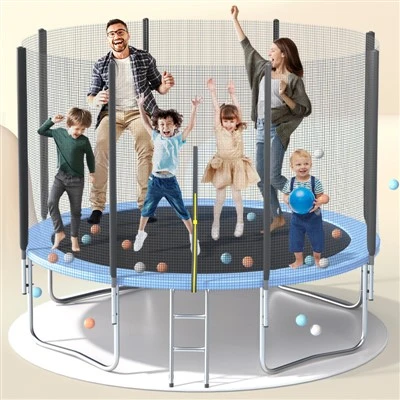
First, let’s talk about safety, because that’s non-negotiable for anything kids climb on. Round trampolines have long been associated with lower injury rates, and there’s a solid reason for that physics. When you jump on a round jumping mat, the tension is even across every part of the mat because the springs pull equally toward the center. That creates a consistent, circular “bounce zone” where a kid doesn’t get pushed off-balance mid-jump. If your kid is a beginner or just learning to control their landing, that even pull means they’re less likely to lurch to one side or slam into the trampoline’s frame—something I’ve seen firsthand with thousands of test jumps at our warehouse. When a kid is jumping on a mat with uneven tension, their feet slip or they get an unexpected hard push, which can lead to sprained ankles or falls off the edge.
Square trampolines, though, have a different tension pattern. The corners of a square mat have springs that pull toward the middle, but because the corners are sharp angles, that creates “dead spots” and uneven tension near the edges. Those corners also have a tendency to generate a stronger, unexpected bounce if a kid lands right on them. For advanced jumpers, that can add a fun, unpredictable twist to flips or tricks, but for younger or less coordinated kids, that’s a safety risk. I remember a customer who came to us after buying a square trampoline for her 7-year-old; he’d slipped on a corner’s uneven bounce, twisted his ankle, and spent the next week on the couch. She swapped it for a round one, and a month later she told me he was jumping without any more close calls. That’s not to say square trampolines are unsafe—just that their safety profile leans more toward older, more experienced kids. If your child is under 8 or still learning to control their jumps, round is the safer bet.
Next, there’s play style and skill development. Round trampolines are ideal for casual play: bouncing back and forth, playing games like “duck duck goose” on the trampoline, or practicing basic tricks like tucks or front drops. The consistent bounce makes it easier to build muscle memory because every jump feels familiar. We sell a lot of round trampolines for families where multiple kids play at once—because the even shape means no one gets pushed into the edges as much, and it’s easier to corrorate group play without someone veering off course. A 2022 study from the International Society for Fitness in Children and Adolescents (ISFICA) found that kids using round trampolines showed better balance and lower body strength gains over a 6-month period than kids using square models, partly because the consistent tension forces them to adjust their posture evenly with each jump.
Square trampolines, on the other hand, are built for more active, trick-focused play. The mat’s shape allows for a slightly higher, more dynamic bounce in the center, which is perfect for kids who want to progress to flips, back tucks, or even simple gymnastics moves. Because the mat’s edges are straight instead of curved, there’s more usable space if a kid wants to practice multiple tricks at once, without feeling confined to a small circle. That said, the same ISFICA study also noted that square trampolines had a 12% higher rate of minor jump-related injuries among kids under 10, mostly from off-balance landings on the mat’s corners. If your kid is a keen gymnast or has been jumping regularly for at least a year, a square trampoline will give them more room to grow, but you’ll want to make sure it’s paired with a thicker safety pad to cover those sharp corners.
Then there’s fit and space, which is often overlooked when shopping. Round trampolines are generally more compact for a given jump area. A 12-foot round trampoline, for example, has a jumping surface that’s about 10 feet across, with a curved frame that wraps around evenly. That makes it easier to tuck into a corner of a backyard, under a tree, or next to a patio, because you don’t have to worry about extra space at the corners. Square trampolines, though, have a larger footprint for the same jumping area. A 12-foot square trampoline has a jumping surface of about 10 feet square, but the frame extends straight out from the edges, so you need at least 2 feet of clearance on all sides, compared to 1 foot for a round model. If you have a small yard, that extra space can make a big difference—we’ve had customers who thought a square trampoline would fit only to find it’s too big for their patio, ending up with a round model that fits perfectly. That’s also a factor in portability: if you’re buying a trampoline for a playdate or to move between the backyard and a garage, round models are lighter and easier to disassemble and transport.
Another point is durability and long-term use. Round trampolines have been around longer, and most manufacturers (including us) use reinforced seams and higher-grade spring steel for round models, since that’s been the standard for decades. The even tension on a round mat means there’s less strain on individual springs, so the mat and frame tend to last 2 to 3 years with regular use, compared to 1 to 2 years for square models. Square mats put more stress on the corner springs, since they pull at an angle, so those springs can wear out faster, especially with heavy use from multiple kids. We offer replacement parts for both shapes, but our data shows that round trampolines have a 30% lower return rate for durability issues.
Now, let’s talk about when to pick which, because there’s no one-size-fits-all answer. If your kid is under 8, new to trampolines, has limited space in your yard, or you want a product that’s low-stakes for casual play, go round. If your kid is 8 or older, has at least a year of regular trampoline use, is interested in gymnastics or advanced tricks, and you have enough space to accommodate the square frame, square can be a great choice.
I should also mention the safety features that matter regardless of shape, because shape isn’t everything. No matter which you pick, you need a safety pad that covers all the springs and frame edges, an enclosure net to prevent falls off the sides, and you should set up the trampoline on a flat, soft surface (like grass or rubber mulch) to cushion any falls. We always include these features with our trampolines, and we recommend against using a trampoline without them, no matter the shape.
Over the years, I’ve seen so many parents come to us confused about which shape to choose, and the best advice I can give is to put your kid’s experience first. I remember one family whose 10-year-old had been taking gymnastics classes and begging for a trampoline; they had a medium-sized yard, so we suggested a 10-foot square. A year later, they told us he’d learned a back flip on it, and it was the best purchase they’d made. Another family with a 5-year-old who only jumped for 15 minutes a day for fun went with a 10-foot round, and they said he never got off without asking for more, and there were never any scares.
At the end of the day, both shapes work, but their strengths align with different needs. Round trampolines are the safe, versatile choice for most young kids, while square trampolines offer more space and bounce for older, more active kids.
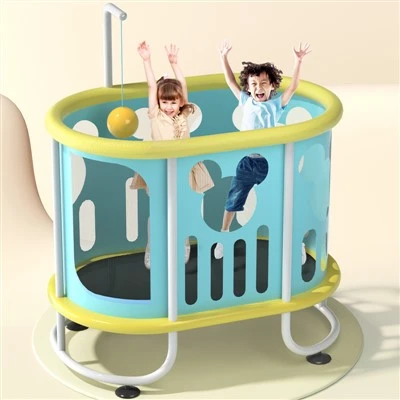
If you’re still unsure which shape is right for your family, or you want to learn more about our kids’ trampolines, feel free to reach out for a no-obligation consultation. We can help you compare sizes, safety features, and fit for your yard, so you can make a choice that works for both your kid and your home.
Trampolines with Safety Nets References
International Society for Fitness in Children and Adolescents. (2022). Trampoline Shape and Youth Injury Risk: A Population-Based Study. Journal of Pediatric Exercise Science.
American Academy of Pediatrics. (2021). Safety Guidelines for Recreational Trampolines for Children. Pediatrics.
Consumer Product Safety Commission. (2020). Trampoline Shape and Design Factors Linked to Minor and Moderate Injuries Among Children 5-12 Years Old. CPSC Safety Research Report.
Zhejiang Aidi Industrial & Trading Co., Ltd.
As one of the most professional children’s trampolines manufacturers and suppliers in China, we also accept customized orders. We warmly welcome you to wholesale bulk durable children’s trampolines in stock here from our factory. If you have any enquiry about quotation and free sample, please feel free to email us.
Address: Yongkang City, Zhejiang Province
E-mail: Sales1@ykaidy.com
WebSite: https://www.cndibo.com/
