If you’ve ever dug into wall hung toilets, you’ve likely stumbled on the term “rough-in” at some point—and if you’re a plumber, a homeowner renovating a bathroom, or someone who’s spent hours geeking out over bathroom fixtures (guilty, I’ve hosted far too many late-night deep dives into flush mechanisms and waste line sizes), you know this isn’t just a random number. It’s the make-or-break measurement that separates a seamless wall hung toilet installation from a weekend full of rerouting pipes, cutting drywall, and cursing poorly planned layouts. As a wall hung toilet supplier, I field this question at least 10 times a week from contractors and homeowners alike: “What’s the average rough-in for a wall hung toilet?” Today, I’m breaking this down, sharing what I’ve learned from 7 years in the fixture business, and why nailing this measurement isn’t just about following rules—it’s about making sure the toilet works, looks right, and stands the test of time. Wall Hung Toilet
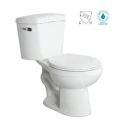
First, let’s start with a quick definition for anyone new to the term, because I promise, not everyone knows what “rough-in” means when it comes to toilets. Rough-in is the distance from the finished wall surface (the tile, the drywall, whatever’s on the wall where the toilet sits) to the center of the toilet’s waste pipe. That’s it. It’s not the distance to the stud, or to the corner of the bathroom—it’s specifically the center point of the drain, measured to the wall you’re mounting the toilet to. For wall hung toilets, this is even more critical than for standard floor-mounted ones, because the toilet tank is concealed in the wall or a wall cabinet, and the waste line runs directly through the wall stud cavity. Get the rough-in wrong by even an inch, and you’ll either have to jerry-rig a pipe that leaks, or tear out half your bathroom to rework the plumbing.
Now, the average rough-in. If I told you it’s a single number, I’d be lying—because like most things in construction, it varies by region, code, and the type of wall hung toilet you’re installing. Let’s start with North America, since that’s where most of our clients are. The industry standard average rough-in for a wall hung toilet in the U.S. and Canada is 12 inches. That’s been the go-to for decades, and it lines up with the most common wall hung toilet models we stock. But wait—before you grab your tape measure, let’s add the fine print. A lot of people don’t realize that this 12-inch number is for the toilet’s rough-in, but some older homes or custom builds use a 10-inch rough-in. That’s not a problem, as long as you match the toilet to the rough-in size. We regularly get calls from plumbers working on 1950s ranch homes, for example, who need a 10-inch rough-in wall hung toilet, and we keep a full stock of those for exactly that reason.
But here’s where it gets interesting: in other parts of the world, the average rough-in is different. In Europe, for example, most wall hung toilets use a 180-millimeter rough-in, which works out to roughly 7 inches. Wait, that’s way smaller—why is that? European bathroom layouts are often more compact, with smaller overall bathroom sizes, so the rough-in is adjusted to fit tighter spaces. Our team often ships custom orders for clients in the UK and Germany that need to adjust mounting plates to fit that 7-inch rough-in, because it’s non-negotiable for the space. And in parts of Asia, we see a mix: some markets use 12 inches, others use 10 inches, but many have specialized wall hung toilets designed for 15-inch rough-ins for larger, more custom bathrooms. That’s why when a client reaches out asking for a rough-in measurement, I always ask where the project is located first—geography matters more than you think.
Now, let’s talk about why the average rough-in isn’t one-size-fits-all, and what factors actually determine the right rough-in for your project. First, building codes. In many U.S. states, the International Plumbing Code (IPC) mandates that wall hung toilets have a rough-in of at least 10 inches, but most manufacturers design their standard models for 12 inches because it’s the most versatile. The Uniform Plumbing Code (UPC), used in some areas of the U.S., aligns closely with that, so 12 inches is the safe bet for most new builds in North America. For older homes, always measure the existing rough-in before buying a toilet—don’t assume it’s 12 inches. A quick trick if you’re measuring an existing floor-mounted toilet: turn the toilet’s base, find the center of the drain, and measure from there to the wall. That will give you the exact rough-in, and you can match a wall hung toilet to that same size to avoid any surprises.
Second, the type of wall hung toilet and mounting system. Wait, most people think the rough-in is just about the waste pipe, but the mounting plate (the metal frame that holds the toilet to the wall) also relies on that measurement. For example, our standard wall hung toilet mounting plates are adjustable between 10 and 12 inches, which means they work for the average rough-in of 12 inches, but can adapt to older homes with 10 inches. That’s a huge selling point for contractors who work on multiple projects in different neighborhoods, because they don’t have to stock multiple mounting plates. But if you’re using a custom wall hung toilet, like a bidet combo or a one-piece model made for luxury bathrooms, the rough-in might be non-adjustable, so you have to get it exact. That’s why we always include rough-in measurement guides with every product we ship, and our customer service team will walk you through measuring your space for free—no sales pitch, just helping you get the job done right.
I want to share a quick story here, because it’s a perfect example of why getting the rough-in right matters. A plumber named Jake reached out to me last year, panicking. He’d ordered 8 wall hung toilets for a new apartment complex in Phoenix, all for 12-inch rough-ins, but when he showed up to install, the builder had accidentally rough-in the drains at 10 inches. He’d already torn out the old floor-mounted toilets, and drywall was already up, so reworking the plumbing would have set the project back 3 days and cost the developer $2,000 in delays. Luckily, a few of our toilet models have adjustable mounting plates, and we had 4 extra units with 10-inch rough-in adaptors in our local warehouse. We shipped them to him that same day, and he was able to install without tearing out drywall. That’s the kind of problem that comes from not double-checking rough-in measurements before ordering, and it’s why I always tell our clients: measure twice, order once. The average rough-in is a guideline, not a rule, and exceptions are common.
Another common misconception: the rough-in is the same for floor-mounted toilets. Nope. Floor-mounted toilets usually have a rough-in of 12 inches too, but they have a wax ring that can adjust slightly, or a closet flange that can be moved a few inches. Wall hung toilets don’t have that luxury—they rely entirely on the exact alignment of the drain pipe and the mounting plate, so even a half-inch difference can cause leaks, or make the toilet sit crooked on the wall. That’s why so many contractors prefer wall hung toilets once they’re familiar with the rough-in process, because they look better, save space, and once installed correctly, they’re nearly maintenance-free. As a supplier, we work hard to make that process easier, whether that’s including pre-cut mounting hardware, or having our team on call to answer rough-in questions at 7 a.m. when a project is running behind.
Let’s circle back to the average rough-in, because there is a number that most plumbers and manufacturers agree on for standard projects. If you’re building a new home in North America, and you’re installing a standard wall hung toilet, the average rough-in you should plan for is 12 inches. That’s the most common size, it aligns with IPC and UPC codes, and it fits 90% of the standard wall hung toilet models on the market. If you’re renovating an older home, measure the existing rough-in first—chances are it’s 10 inches, so you’ll need a toilet designed for that size. If you’re working in Europe, 7 inches (180 mm) is the average rough-in, and in compact bathrooms, that’s non-negotiable. For commercial projects, like office buildings or retail spaces, we often recommend 12 inches too, because it’s easier to service and works for a wider range of models.
Now, what about factors that might make you deviate from the average rough-in? If you have a very small bathroom, for example, you might consider a wall hung toilet with a 10-inch rough-in, which can save a few inches of space compared to 12. If you’re installing a bidet attachment, some manufacturers recommend a slightly different rough-in to accommodate the plumbing for the bidet nozzle, so that’s a question to bring up with your toilet supplier. And always make sure that the rough-in matches the toilet’s trapway size—most wall hung toilets have a 3-inch trapway, which is the standard for North America, but some smaller models have a 2-inch trapway, so you’ll want to confirm that the drain pipe matches that size too.
As a wall hung toilet supplier, I’ve seen firsthand how a small measurement like rough-in can make or break a project. Too many homeowners and contractors skip the step of measuring the rough-in, and end up with a toilet that doesn’t fit, leaks, or looks crooked. That’s why we prioritize educating our clients as much as we do selling products—we don’t just want you to buy a toilet, we want it to work perfectly. If you’re planning a project and you’re not sure what rough-in you need, or you have questions about matching a toilet to your space, our team is here to help. We stock a full range of wall hung toilets in all average and non-average rough-ins, from budget-friendly models for residential renovations to luxury bidet combos for high-end commercial builds.
At the end of the day, the average rough-in for a wall hung toilet is just a starting point. It’s a guideline, a rule of thumb, but the right rough-in for your project depends on location, age of the home, bathroom size, and the type of toilet you’re installing. Don’t rely on guesswork—measure twice, check local codes, and if you’re not sure, reach out to a supplier that knows wall hung toilets inside and out. We’ve spent years refining our inventory, our customer service, and our installation guides to make this process as easy as possible, because we know that a well-installed wall hung toilet starts with getting the rough-in right.

If you’re working on a bathroom project and you need help figuring out the right rough-in, or you’re ready to order wall hung toilets for your next job, get in touch with our team to discuss your needs. We’re happy to answer any questions, walk you through measurements, and help you find the perfect toilet for your space.
One Piece Toilet References:
International Plumbing Code (IPC). (2021). International Code Council.
Uniform Plumbing Code (UPC). (2022). International Association of Plumbing and Mechanical Officials.
European Standard EN 33:2019, Sanitary appliances – Water closets for connection to drainage systems – Dimensions and requirements.
Residential Construction Specifications for Wall-Hung Fixtures. (2023). National Association of Home Builders.
Tangshan Houfengyuan Import and Export Co., Ltd.
As one of the most professional wall hung toilet manufacturers and suppliers in China, our products have good reputation in the market. We warmly welcome you to wholesale customized wall hung toilet from our factory. Good service and quality products are available.
Address: COMPREHENSIVE SERVICE PARK BUILDING,No.3 ROOM 216 MEIYI ROAD No.14 LUBEI,TANGSHAN CITY, HEBEI PROVINCE,CHINA
E-mail: hfy01@hfybath.com
WebSite: https://www.hfy-bath.com/
