If you’ve ever driven past a sprawling electrical substation—those fenced-off compounds with towering metal frameworks, humming transformers, and thick power lines stretching in every direction—you might’ve wondered what holds all that gear up and keeps it safe. As a supplier specializing in substation structures, I hear this question all the time from electrical engineers, construction crews, and even local residents curious about the quiet backbone of our power grid. Today, let’s break down exactly what a substation structure frame is, why it matters, and how we design and build these critical components to stand the test of time. Substation Structures

First, let’s start with the basics. A substation structure frame is the load-bearing, steel-built skeleton that supports every piece of equipment in a high-voltage substation. Think of it as the nervous system of the substation, without which transformers, circuit breakers, busbars, and insulators would have no stable, organized place to live. Substations serve a key role in moving electricity from power plants to homes and businesses: they step voltage up for long-distance transmission, step it down for local distribution, and reroute power during outages. Every part of this operation relies on the structure frame to hold heavy gear at precise heights, keep conductive parts separated to prevent dangerous arcs, and withstand extreme weather year-round.
You might be surprised at how varied these frames are, because no two substations are exactly alike. The size, shape, and load requirements shift dramatically depending on the substation’s purpose. For example, a small distribution substation in a residential neighborhood might only need a compact frame to support a single pad-mounted transformer and a few switchgears, while a massive transmission substation on a busy corridor will require massive, lattice-style frames that hold dozens of transformers, high-voltage circuit breakers, and long busbars stretching hundreds of feet. Even the location matters: frames built for coastal areas have to resist saltwater corrosion, while frames in tornado-prone regions need extra bracing to survive high winds.
Let’s get into the core components that make up a typical substation structure frame, because they’re not just random steel beams bolted together. First, there are the main support columns, often made of hot-rolled steel or galvanized steel that’s been coated to resist rust. These columns are anchored deep into concrete foundations, sometimes 10 or 15 feet below ground, to keep the entire frame from shifting even during an earthquake or strong storm. Next come the cross-arms and beams that stretch between the columns—these are the parts that actually hold the equipment. For busbars, the thick, heavy lines that carry high-voltage current between devices, you’ll see specialized bus support insulators mounted on these beams, spaced at exact intervals to prevent the busbars from sagging or touching other conductive parts, which would cause a short circuit.
Then there’s the bracing system, which is what makes the frame stable. Most frames have diagonal steel braces between columns and beams, designed to distribute weight and force evenly across the entire structure. This is non-negotiable for safety: a single sagging beam or unbraced column can lead to equipment damage, power outages, or even worker injuries during installation. Some larger frames also have secondary support structures for smaller equipment like lightning arresters, voltage regulators, and control cabinets, making sure every part of the substation is held in the right place for reliable operation.
Now, as someone who’s been supplying substation structures for over 15 years, I can tell you that building a good frame isn’t just about following a blueprint—it’s about balancing engineering precision with real-world demands. Let me walk you through a recent project I worked on to illustrate this. Last year, we supplied frames for a new transmission substation in the Pacific Northwest, an area that sees heavy rain, snow, and occasional seismic activity. The engineering team specified a lattice-style frame, which is lighter than solid steel but just as strong, perfect for supporting 12 transformers and 30 high-voltage circuit breakers. We used hot-dip galvanized steel for all components to resist corrosion from the region’s moist air, and added extra cross-bracing to meet the local building code’s seismic requirements, which meant the frame had to withstand a 7.0 magnitude earthquake without shifting more than a few millimeters.
What’s interesting is that a lot of people don’t realize how much goes into the design before the steel even hits the job site. Our engineering team doesn’t just pull a generic frame design from a catalog—we work closely with the substation’s client, whether that’s a power utility, an EPC (Engineering, Procurement, Construction) firm, or a municipal power department, to gather specific data. That includes the weight of every piece of equipment being installed, the height requirements for busbars to maintain safe electrical clearance, local wind and snow load data, seismic zone ratings, and even environmental restrictions, like if the substation is being built near a wetland and needs to have non-corrosive materials that won’t leach into the ground.
For example, when a client needs a frame that can support a 500 kV busbar—one of the highest voltage levels used in transmission—the clearance between the busbar and the ground or other equipment has to be at least 25 feet, per national electrical safety standards. Too low, and there’s a risk of an arc flash, a dangerous electrical discharge that can cause burns, fires, or explosions. Too high, and you’re wasting steel and money, since the frame doesn’t need to be taller than necessary. This is where our experience comes in: we calculate every load, every wind force, every clearance requirement to build a frame that’s safe, cost-effective, and long-lasting.
Another key part of our work as a substation structure supplier is custom fabrication. No two projects are the same, so we don’t offer one-size-fits-all frames. For a small distribution substation serving a new housing development, we might design a compact, bolted frame that can be assembled in just a few days, reducing installation time and labor costs. For a heavy industrial substation powering a manufacturing plant, we might build a frame that can support 100-ton transformers, with reinforced columns and extra bracing to handle that enormous weight. We also offer modular frames, which are pre-fabricated in our shop then shipped to the job site and assembled quickly—this cuts down on on-site construction time, which is a big plus for clients who need their substation up and running fast to meet power demand.
Durability is another non-negotiable. A substation structure frame is designed to last 50 years or more, often in harsh conditions. That’s why we use hot-dip galvanizing for almost all our steel components: this process coats the steel in a layer of zinc that prevents rust, even if the frame is exposed to rain, salt air, or snow for decades. We also test every frame’s load capacity before it leaves our facility, using computer simulations and physical load tests to make sure it meets all industry standards, like those set by the Institute of Electrical and Electronics Engineers (IEEE) and the National Electrical Safety Code (NESC).
I’ve seen first-hand what happens when a frame is built to cut corners. A few years ago, I consulted on a small substation that had been installed by a cheap, unqualified supplier. The frame used thin steel beams that weren’t properly braced, and the galvanizing had been skipped to save money. Within three years, the columns were rusting through, the beams were sagging, and the substation had to be shut down for emergency repairs. That’s not just a hassle for the utility—it means thousands of residents were without power for days, and the repair costs ended up being far higher than if they’d used a reputable supplier from the start. That’s why we prioritize quality over cost in every frame we build; we know our work keeps the power on for millions of people.
So, to recap: a substation structure frame is the engineered steel skeleton that supports all equipment in a substation, designed to hold heavy gear at precise heights, maintain safe electrical clearances, withstand extreme weather and seismic activity, and stand reliably for decades. It’s not just a bunch of steel beams—it’s a critical part of the power grid, enabling the safe, efficient movement of electricity from power plants to homes and businesses.
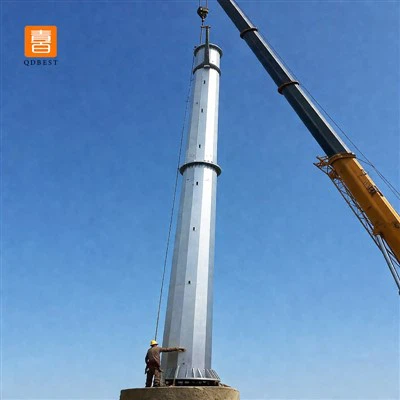
If you’re an electrical engineer, project manager, or utility professional working on a substation project, I’d be happy to walk through how our team can design and build a custom frame that fits your exact needs. Whether you’re working on a small distribution substation, a large transmission facility, or an industrial power center, we have the experience and engineering expertise to deliver a frame that’s safe, durable, and cost-effective. Reach out to our team to discuss your project details and get a quote that works for you.
Tubular Tower References:
- National Electrical Safety Code (NESC) 2023 Edition
- Institute of Electrical and Electronics Engineers (IEEE) Standard 1595-2018, Standard for Substation Structure Design
- American Institute of Steel Construction (AISC) Steel Construction Manual, 15th Edition
- Substation Structures: Design, Construction, and Maintenance, Electric Power Research Institute (EPRI) 2021 Report
Qingdao BEST Steel Structure Co., Ltd.
Qingdao BEST Steel Structure Co., Ltd. is one of the most professional substation structures manufacturers and suppliers in China. We warmly welcome you to buy customized substation structures made in China here from our factory. If you have any enquiry about OEM service, please feel free to email us.
Address: Jiaobei Industrial Park, Qingdao, China
E-mail: salesmanager@qdbsstower.com
WebSite: https://www.qdbsstower.com/
