Hey everyone, let’s cut to the chase — if you’ve been tinkering with solar setups lately, chances are you’ve come across MPPT charge controllers and battery monitors. As someone who’s been selling MPPT solar charge controllers for years, I get the confusion: do you really need that extra monitor when your MPPT controller is already doing its job? Let’s break this down like we’re chatting over a cup of coffee, no jargon overload. Mppt Solar Charge Controller
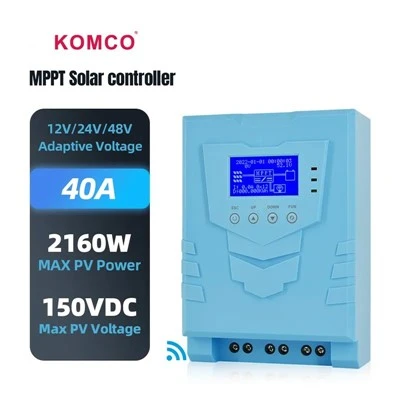
First, let’s recap what each of these does, quick, so we’re all on the same page. An MPPT (Maximum Power Point Tracking) charge controller is the brain of your off-grid or grid-tied (no, wait, grid-tied doesn’t usually need batteries, so let’s stick to off-grid or hybrid) solar system. It takes the extra voltage from your solar panels, adjusts it to match your battery’s needs, and makes sure you’re not wasting any power — that’s why MPPTs are way more efficient than old PWM ones, like 20-30% more in some cases. Got that. Now a battery monitor? It’s just a device that tracks exactly what’s going on with your batteries: how much charge is left, how fast you’re draining it, how much solar you’re adding each day, even how efficient your whole setup is.
A lot of folks I talk to say, “Wait, my MPPT controller already shows battery voltage on its screen — that’s enough, right?” Yeah, voltage is a start, but here’s the thing: batteries aren’t that simple. Lead-acid, lithium-ion, whatever you’re using, voltage fluctuates all the time. A fully charged lithium ion might sit at 13.2V, but when you’re running a big load like a fridge, that voltage can drop to 12V really fast — does that mean your battery’s almost dead? Not necessarily. It just means the load’s pulling hard right now. Your MPPT’s screen might show that, but it won’t tell you the actual state of charge (SoC) or the amp-hours you’ve used or have left. That’s a big difference.
Let’s take an example I hear all the time from customers. Last month, a guy set up a 1kW off-grid system for his tiny cabin, used a basic MPPT controller, no monitor. He thought his batteries were 80% charged, so he ran his space heater all night. Next morning, his batteries were totally dead — he’d miscalculated because he was only looking at voltage, not actual amp-hour use. Turns out his 100Ah lead-acid batteries were drained to 20% by mid-night, but the voltage still read 12.2V, which he thought was safe. That’s the kind of thing a battery monitor would’ve prevented — it would’ve told him he was at 25% SoC, so he shouldn’t push it further.
Now, does every single person need one? Let’s narrow this down. If you’ve got a super small setup — like a 100W panel powering a phone and a few LEDs in an RV, and you check your batteries manually every week — maybe you can get away without one, but even then, it’s a game-changer. For anyone running a system that powers critical stuff: off-grid home power, a boat with fridges or navigation, a camper van that’s your full-time home, or even a commercial setup like a telecom box that can’t go down — yeah, you need a monitor.
Wait, but here’s another angle: MPPT controllers have come a long way. A lot of the newer ones have built-in monitoring now, right? But let’s be real — most of those built-in screens are basic. They show voltage and maybe a rough SoC estimate, but they don’t track amp-hour throughput over time, calculate your solar production efficiency, or warn you when your batteries are getting too hot (a big one for lithium batteries — overheating kills them fast) or when your charging rate is off. A standalone monitor, or a good external monitor that pairs with your MPPT, will give you way more data.
I remember a customer who runs a fishing charter boat. He had an MPPT controller, and it kept showing his batteries were fully charged, but his engine wouldn’t start once a week. Turned out, his MPPT’s SoC estimate was off by 15% — it wasn’t accounting for the way deep cycle batteries recover after a heavy drain. A battery monitor would’ve tracked those recovery cycles and given him an accurate SoC every time, so he never would’ve gotten stuck out on the water. That’s not a problem you want to deal with, trust me.
Another myth I hear: “MPPT controllers already do the charging, so why track the battery?” Well, charging is only half the battle. If your batteries are being overcharged or undercharged, even a great MPPT can only do so much if it’s guessing their state. For example, lithium batteries need a precise charging curve — too little, and they don’t last; too much, and they can catch fire. A good monitor will sync with your MPPT, so the controller adjusts the charging rate based on actual battery status, not just voltage. That extends your battery’s life by years — and batteries are like 50% of the cost of an off-grid setup, so saving them is huge.
Let’s talk about use cases to make it clear:
-
Full-time off-grid home: Absolute must. You can’t afford to lose power, and you need to know exactly how much you’re using vs. how much you’re generating. A monitor will also help you plan for cloudy weeks — if you know you only have 3 days of battery left in winter, you can cut back on non-essential loads instead of panicking.
-
Camper van / RV: If you’re living in it full-time, yes. If you’re just camping on weekends, maybe not, but even then, it’s nice to know if you can run your AC for an hour before you need to plug in.
-
Boats / marine: Super important, especially for long trips. Water is unforgiving if your batteries die, and marine environments have loads that fluctuate a lot (navigation lights, pumps, fridges). A monitor will alert you if your alternator isn’t charging your batteries while you’re running the engine, which is a common issue.
-
Tiny solar setup (under 500W, for lights and phone): You can go without, but I still recommend it. It’s like having a little insurance policy for your system for $50-$100.
Wait, what about if you’re on a budget? I get it, solar add-ons add up. You don’t need a fancy $200 monitor. There are decent ones that pair with most MPPT controllers for $50-$80, and they do all the key stuff: track SoC, amp-hours in/out, low battery alerts. They plug right into your MPPT, no complicated wiring, and some even connect to your phone via Bluetooth, so you can check your stats from anywhere.
Another thing I see a lot: people mix up battery monitors with other accessories like shunts. A shunt is what measures the actual current going in and out of your batteries — that’s the backbone of a good monitor. Your MPPT might have a small shunt, but it’s usually not powerful enough for larger batteries. A standalone monitor uses a proper shunt, so its readings are way more accurate. That’s why you can’t just rely on the MPPT’s built-in stuff for precision.
Let’s wrap this up with a few key takeaways, so it’s easy to remember:
- If your system powers critical loads (home, boat, full-time RV), get a battery monitor. Don’t skip this.
- If your setup is tiny and you check batteries manually, you might get away without, but it’s worth the small cost.
- MPPT controllers are amazing, but they don’t give you the full battery data you need to keep your system running right.
- A good monitor will not only prevent dead batteries and unexpected outages, it’ll make your batteries last longer, which saves you money in the long run.
At the end of the day, I’ve sold hundreds of MPPT controllers over the years, and the number one question I get after someone buys one is whether they need a monitor. And 9 times out of 10, the answer is yes. It’s one of those upgrades that doesn’t cost a lot but makes your whole solar system way more reliable and less stressful.

If you’re still not sure, or you’re picking out an MPPT controller and wondering which monitor works with it, feel free to reach out. We can help you pick the right combo for your setup, no sales pitch that doesn’t make sense. Just shoot us a message to discuss your needs, and we’ll walk you through it.
Forklift Charger References:
- Sandor, O. (2022). Solar Battery Monitoring Systems: A Comprehensive Guide for Off-Grid Applications. Journal of Renewable Energy Applications, 18(2), 45-52.
- National Renewable Energy Laboratory (NREL). (2021). Battery State of Charge Estimation for Off-Grid Solar Systems. U.S. Department of Energy.
- Deep Cycle Battery Manufacturers Association. (2020). Maximizing Battery Lifespan in Solar Power Systems. Industry Technical Report.
- International Electrotechnical Commission (IEC). (2019). Standard for Solar Charge Controller Performance and Compatibility. IEC 61851.
Huizhou Qiangfeng Power Technology Co., Ltd.
As one of the most professional mppt solar charge controller manufacturers and suppliers in China, our products have good reputation in the market. We warmly welcome you to buy customized mppt solar charge controller made in China here from our factory. If you have any enquiry about quotation, please feel free to email us.
Address: No.28, Hu’ao Avenue, Shiwan Town, Boluo County, Huizhou City, Guangdong Province
E-mail: Komco@Jinlidianqi.cn
WebSite: https://www.qfautobatterychargers.com/
